Choosing the right RFID technology is one of the most important decisions in an RFID access control project. A short-range employee card reader, a long-range vehicle gate reader, and an active RFID personnel identification system may all support controlled entry, but they are designed for very different operating conditions.
The best RFID access control technology depends on who or what is entering, how far away the credential must be read, how quickly people or vehicles move through the access point, and how much control is needed over the read zone. For example, an office door often requires intentional card presentation at close range, while a parking gate may require automatic identification of authorized vehicles before they reach a barrier.
This guide compares 13.56 MHz proximity RFID, passive UHF Gen 2 RFID, and active RFID technologies to help facility managers, security teams, system integrators, and industrial operators choose the right approach for personnel doors, vehicle gates, parking areas, warehouses, and multi-site facilities.
Not all RFID access control systems need the same read range. Selecting a reader with a longer range than necessary can create operational problems, such as reading credentials from nearby lanes, adjacent doors, or people who are close to an entrance but are not attempting to enter.
Before choosing an RFID reader or tag, define the real access scenario:
In general, 13.56 MHz RFID is commonly used for controlled, close-range credential presentation. UHF RFID is more suitable when longer reading distance is needed, especially for vehicle gates and hands-free identification. Active RFID can support longer-range identification and managed-zone applications where battery-powered tags are appropriate.
Actual read range depends on reader power, antenna configuration, tag type, tag placement, surrounding materials, frequency regulations, and the physical layout of the entrance. The best choice is not always the technology with the longest possible read distance. The right choice is the technology that creates a predictable and controlled access workflow.
13.56 MHz RFID is a high-frequency technology commonly used with proximity cards, smart cards, key fobs, wristbands, and other close-range credentials. It is often a practical choice for office doors, staff entrances, fitness centers, controlled rooms, laboratories, educational facilities, and indoor access points where users can intentionally present a card or credential.
For RFID access control at a door, short-range reading is often an advantage rather than a limitation. It creates a deliberate interaction: the authorized user walks to the door, presents a credential near the reader, and the system checks the assigned access permissions before activating the connected lock, strike, gate, or relay.
| Access Scenario | Recommended Credential | Why It Works |
|---|---|---|
| Office staff door | 13.56 MHz card or key fob | Supports controlled, close-range credential verification. |
| Fitness center entrance | RFID membership card or wristband | Convenient for members and easy for administrators to manage. |
| Restricted laboratory | 13.56 MHz smart card | Suitable for intentional access verification at sensitive doors. |
| Warehouse staff room | Employee RFID credential | Can support access permissions based on employee role or schedule. |
| Visitor entrance | Temporary RFID card | Can be issued, time-limited, deactivated, and collected after use. |
| Equipment room | Short-range RFID credential | Helps reduce unintended long-range reads near controlled areas. |
NephSystem’s Access Control Elite solution supports optional 13.56 MHz proximity RFID readers, including the N670 wall-mounted reader. The N670 supports ISO14443A, Ethernet or PoE connectivity, dry-contact relay functions, and IP68-rated protection for projects that require a durable reader installation.
Passive UHF RFID typically operates in the 860–960 MHz range, depending on local and regional frequency regulations. UHF RFID is used when a reader needs to identify a credential from a longer distance than a proximity card reader can support.
For RFID access control projects, UHF is often most useful for vehicle gates, parking lots, industrial campuses, logistics yards, warehouses, gated facilities, and other entrances where drivers should not need to stop, open a window, or manually present a card.
A typical vehicle access setup uses a UHF RFID windshield tag installed on an authorized vehicle and a long-range reader positioned near the entry lane. When the vehicle approaches within the configured read zone, the system can validate the credential and trigger a barrier, gate, garage door, or other connected access device.
Vehicle access is one of the most common applications for long-range UHF RFID. A vehicle-mounted tag can be read before the driver reaches the barrier, allowing the system to validate the credential and issue an open command when access is permitted.
However, read range alone should not determine the RFID access control design. The goal is not simply to read a tag from the farthest possible distance. The goal is to create a predictable read zone that identifies the intended vehicle in the intended lane.
For example, a reader positioned too broadly may detect a vehicle waiting in an adjacent lane, a nearby parking space, or an exit lane. A reader positioned too narrowly may miss tags when a vehicle is not aligned correctly. Antenna orientation, reader mounting height, vehicle direction, windshield tag position, lane width, reader power, and nearby metal structures can all affect actual performance.
| Design Factor | Why It Matters |
|---|---|
| Lane width | Wider lanes may require more controlled antenna placement or additional coverage planning. |
| Vehicle speed | Faster vehicles may require earlier credential detection and a carefully configured read zone. |
| Windshield tag location | Incorrect tag placement can reduce read consistency. |
| Antenna orientation | Reader and antenna alignment affect tag recognition and the shape of the read zone. |
| Reader mounting position | The mounting angle and height affect whether the intended vehicle is detected at the correct point. |
| Adjacent traffic lanes | Physical separation and RF tuning help reduce cross-lane reads. |
| Metal structures | Metal gates, fences, barriers, and vehicles can affect RF performance. |
| Outdoor conditions | Reader housing, cables, enclosures, and mounting hardware should match the installation environment. |
| Regional regulations | UHF operating bands, power limits, and RFID requirements may differ by market. |
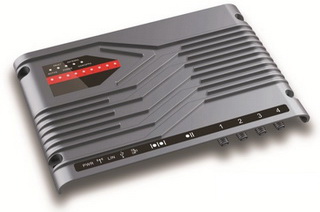
NephSystem’s N680 is an optional 860–960 MHz UHF Gen 2 RFID reader for long-range RFID access control applications. It supports Ethernet or PoE connectivity, includes four ports and a dry-contact relay, and has an IP54 rating. It can be considered for vehicle entry and parking scenarios when reader placement, tag selection, antenna design, and lane layout are evaluated as part of the full deployment.
For more information about long-range vehicle and gate applications, see our UHF RFID access control guidance.
Active RFID tags use an internal power source, usually a battery, to support longer-range identification or continuous signaling. In access-related environments, active RFID can be useful when passive RFID read range is insufficient, when a project needs larger managed zones, or when tags are associated with people, assets, vehicles, or specialized operating areas.
Active RFID should not automatically be viewed as the best option just because it can support longer read distances. It introduces additional operational considerations, including tag battery maintenance, replacement planning, tag lifecycle management, and potentially higher tag costs.
For controlled door entry, a short-range proximity card may still be the better choice. For vehicle gate access, passive UHF RFID may offer a lower-maintenance and more cost-effective option. Active RFID becomes more relevant when the site requires extended-range identification, specialized tracking workflows, or larger-area monitoring requirements.
NephSystem offers optional 2.45 GHz active RFID reader options, including the NSAR-850 and NSAR-800. These readers can support long-range active RFID workflows and include dry-contact relay capability. Depending on the selected configuration, power can be supplied through DC input or PoE.
The table below provides a practical starting point for RFID access control planning. Actual performance should always be validated through on-site testing with the intended reader, antenna, tag, credential location, access point layout, and environmental conditions.
| Factor | 13.56 MHz RFID | Passive UHF RFID | Active RFID |
|---|---|---|---|
| Common operating range | 13.56 MHz | Typically 860–960 MHz, depending on region | Varies by technology; active RFID commonly uses dedicated frequency bands |
| Typical credential | Smart card, proximity card, key fob, wristband | Windshield tag, hard tag, UHF card, vehicle tag | Battery-powered active tag |
| Typical read distance | Short range, designed for close credential presentation | Multi-meter range depending on reader, antenna, tag, and environment | Can support longer-range managed-zone identification |
| Best for | Personnel doors, controlled rooms, office access | Vehicle gates, parking entry, long-range identification | Large-area or specialized long-range identification |
| User action | Usually intentional credential presentation | Often hands-free or automatic | Often hands-free or automatic |
| Vehicle suitability | Limited unless the vehicle stops near the reader | Well suited for vehicle and parking access | Suitable for selected long-range vehicle workflows |
| Personnel suitability | Well suited for controlled door entry | Can work when read zones are carefully designed | Suitable for selected tracking or zone-based applications |
| Tag maintenance | Low | Low | Requires battery lifecycle management |
| Main deployment priority | Controlled credential presentation | Reader placement and read-zone control | Battery maintenance and zone design |
| Key risk to manage | User convenience at high-traffic doors | Cross-lane reads or unintended tag reads | Battery replacement and overly broad detection zones |
For offices, meeting rooms, employee entrances, server rooms, laboratories, and staff-only spaces, 13.56 MHz RFID is often a practical choice. Employees can use cards, key fobs, or wristbands, while administrators can manage permissions based on job role, department, schedule, or location.
The controlled reading behavior of proximity RFID helps ensure that the reader detects the credential intentionally presented at the door.
Fitness centers and membership facilities often need a credential that is easy to use, durable, and convenient for members. RFID cards, key fobs, and wristbands can support entry control while allowing administrators to manage memberships, schedules, access zones, and temporary restrictions.
Wristband credentials can be useful where users may not want to carry a wallet or physical card during activity.
For parking entrances, corporate campuses, industrial sites, gated facilities, and logistics locations, passive UHF RFID is often a suitable option. A windshield tag can identify an approved vehicle as it approaches the entrance, allowing a connected barrier or gate controller to grant entry without requiring the driver to stop and present a card.
The deployment should include on-site testing to confirm that the reader detects the correct vehicle in the correct lane at the correct time.
For parking and vehicle-entry projects, visit our RFID parking and vehicle gate design guide.
Industrial environments may include employee entrances, warehouse doors, vehicle gates, loading areas, maintenance rooms, restricted production zones, and visitor checkpoints. In these projects, one RFID technology may not be sufficient for every access point.
A mixed RFID access control approach may include:
This approach helps an organization match the credential type and reader technology to each operational requirement instead of forcing every entrance to use the same RFID method.
Yes. A centralized RFID access control platform can be designed to manage different RFID reader types and credential formats across a facility, provided the hardware, communication methods, software configuration, and access rules are compatible.
For a multi-door or multi-site facility, the goal is usually to manage access events through one administrative environment. This can include employee cards for building doors, vehicle tags for parking gates, temporary credentials for visitors, and access schedules for different shifts or locations.
NephSystem Access Control Elite is designed to combine 13.56 MHz smart RFID cards, UHF Gen 2 credentials, proximity RFID readers, long-range RFID readers, control software, and electronic locks or strikes in one personnel and vehicle identification management solution.
The system supports real-time activity monitoring, real-time map views, event notifications, access logs, customizable schedules, user and vehicle profiles, tag management, and report generation in PDF or Excel format.
Explore NephSystem’s RFID personnel and vehicle access solution for centralized access management across doors, gates, parking areas, and industrial sites.
Start
↓
Who needs to be identified?
↓
Personnel only → Does the user need to intentionally present a credential?
↓
Yes → Use a 13.56 MHz RFID card, key fob, or wristband reader.
No / Hands-free preferred → Evaluate UHF or active RFID based on required distance and read-zone control.
↓
Is vehicle access required?
↓
Yes → Is automatic gate opening required from several meters away?
↓
Yes → Consider a passive UHF windshield tag and long-range RFID reader.
No → Use a short-range card, fob, or controlled vehicle credential workflow.
↓
Does the project require extended-range zone identification?
↓
Yes → Evaluate active RFID and prepare a tag battery management plan.
No → Choose the simplest RFID technology that meets the required read distance.
Before requesting a system recommendation, prepare the following information:
| Project Requirement | Questions to Answer |
|---|---|
| Access point type | Is it a door, turnstile, parking barrier, vehicle gate, warehouse entrance, or restricted area? |
| User type | Will the credential be carried by employees, visitors, contractors, drivers, or vehicles? |
| Required read range | Does the user need to tap, walk through, or drive through the entry point? |
| Traffic volume | How many people or vehicles pass through during peak periods? |
| Credential type | Will the project use cards, key fobs, wristbands, windshield tags, or active tags? |
| Environment | Is the installation indoor, outdoor, dusty, wet, hot, cold, or exposed to vibration? |
| Network connection | Is Ethernet available? Can the site use TCP/IP or PoE? |
| Access device | Will the reader activate a lock, electric strike, turnstile, barrier, gate, or another relay-controlled device? |
| Management rules | Are permissions based on location, role, department, shift, holiday, or vehicle type? |
| Reporting needs | Does the site need real-time monitoring, email alerts, access logs, floor maps, PDF reports, or Excel exports? |
| Expansion plans | Will more doors, buildings, users, vehicles, or access zones be added later? |
UHF RFID can be used for pedestrian access control, especially when hands-free identification or longer read range is needed. However, the read zone must be designed carefully to avoid detecting badges or tags belonging to people near the entrance but not attempting to enter. For many standard office doors and controlled rooms, 13.56 MHz proximity RFID remains the more predictable option.
For most office doors, staff rooms, and controlled indoor access points, 13.56 MHz RFID is often suitable because it supports intentional, close-range presentation of a card, fob, or wristband.
Passive UHF RFID is commonly used for vehicle gates and parking entrances because a vehicle-mounted tag can be read at a longer distance than a proximity card. The final design should account for tag placement, reader orientation, lane layout, vehicle speed, and nearby structures.
Yes. A centralized RFID access control platform can manage employee and vehicle credentials when the system supports the required reader types, credential formats, access rules, and reporting functions. This allows administrators to manage personnel doors, parking gates, vehicle entry permissions, schedules, and event logs from one management environment.
No. Active RFID can support longer-range identification, but it also requires battery-powered tags and an ongoing battery maintenance process. Passive RFID may be more practical for many personnel-door and vehicle-gate applications because passive cards and tags do not require batteries.
False reads can be reduced by controlling reader power, antenna placement, read-zone direction, tag mounting position, lane layout, and physical separation from nearby lanes or parking areas. On-site testing is important because real-world performance is affected by vehicles, metal, glass, gate structures, and local RF conditions.
Yes. RFID access control platforms can be configured to grant or deny entry according to assigned roles, locations, schedules, shifts, holidays, and temporary access periods. This can help organizations manage employee access, visitor permissions, contractor credentials, and vehicle-entry rules more consistently.
The right RFID access control technology is not determined by frequency alone. It depends on the physical entrance, the user or vehicle being identified, the required read distance, the desired level of control, and the operational workflow behind the access point.
Use 13.56 MHz RFID when users need controlled, close-range credential presentation at doors and indoor access points. Consider passive UHF RFID when vehicles or long-range identification require hands-free entry. Evaluate active RFID when the project requires extended-range identification, larger managed zones, or specialized tracking workflows and can support tag battery management.
For facilities that need to manage personnel doors, vehicle gates, access schedules, real-time entry records, alerts, and reports from one platform, review NephSystem’s RFID access management options for personnel and vehicles.


