RFID People Tracking uses radio-frequency identification tags (badges, wristbands, or implants) and readers to monitor personnel locations in real-time, enhancing safety, workflow, and compliance across industries. Hospitals track patients to prevent elopement; construction sites locate workers amid hazards; events manage crowds for security. Systems deliver sub-meter accuracy via passive/active RFID, RTLS (Real-Time Location Systems), or hybrids with Wi-Fi/Bluetooth.
Customers seek RFID People Tracking solutions balancing precision, scalability, and privacy—especially post-pandemic for contact tracing and capacity control. Government guidelines emphasize encrypted data and consent protocols. This guide answers top questions from RFID People Tracking customers, from tech specs to ROI, helping facilities choose reliable RFID People Tracking suppliers.
Core Components and Technology
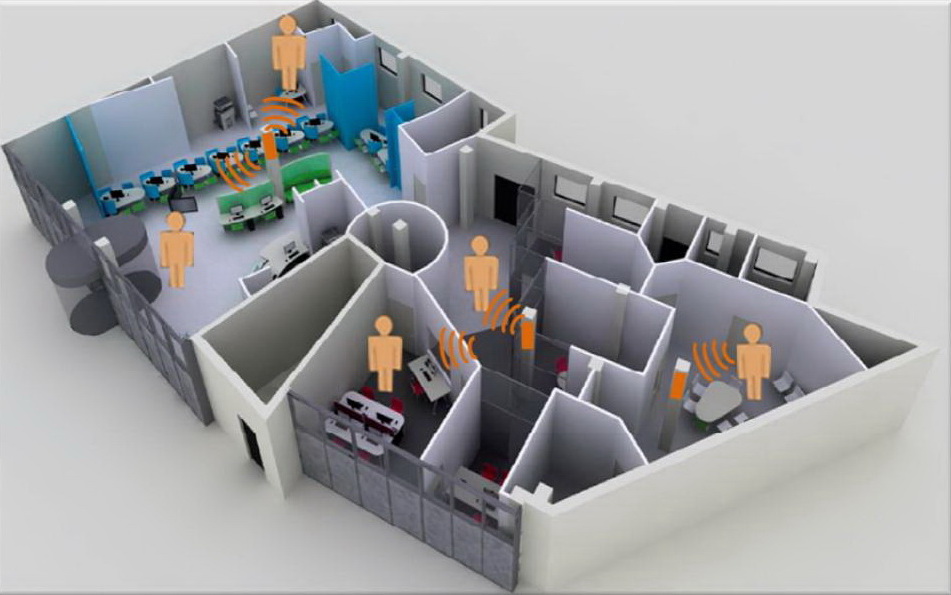
RFID People Tracking deploys:
Tags/Badges: Passive (UHF 860-960MHz, read range 5-10m) or active (battery-powered, 50-100m). Store ID, health data, access rights.
Readers/Gateways: Fixed (corridors/doors) or mobile; capture signals every 1-5 seconds.
Software/Cloud: RTLS engines triangulate via Time-of-Arrival (ToA) or Angle-of-Arrival (AoA); dashboards show heatmaps, alerts.
In hospitals, staff badges trigger zone alerts (e.g., "Dr. Smith at Bed 12"). Construction RTLS uses "assistant tags" for signal reliability amid obstacles. University studies confirm 95%+ accuracy in controlled environments.
Passive suits high-density (events); active excels in large/open areas (warehouses). Hybrids integrate UWB for cm-level precision.
Passive UHF: 3-5m accuracy, 10m read range. Active: 1-3m, 100m+. RTLS boosts to <1m via multi-reader triangulation. Obstacles reduce by 20-30%; construction tests show 90% reliability with repeaters. RFID People Tracking suppliers calibrate for site-specific RF noise.
Yes—with safeguards. EU GDPR/CCPA require consent, data minimization (e.g., 24hr retention), anonymization. VA.gov mandates encryption, SSO integration. No constant surveillance; alerts only (e.g., "unauthorized zone"). Case studies note profiling risks if unencrypted. Opt-in badges address union concerns.
| Scale | Tags | Readers | Software | Annual | ROI Timeline |
|---|---|---|---|---|---|
| Small (Hospital Ward) | $2-5 ea | $500-1K | $5K/yr | $2K | 6-12 mo |
| Medium (Factory) | $3-7 ea | $1-2K | $10K/yr | $5K | 12-18 mo |
| Large (Campus) | $5-10 ea | $2-5K | $20K+/yr | $10K | 18-24 mo |
ROI via 30% faster response (lost staff), 20% safety gains.
APIs link to EHR (Epic/Cerner), CMMS, access control. VA RTLS uses IAM/SSO. Cloud dashboards (AWS/Azure) enable mobile alerts. Battery life: passive unlimited, active 2-5 years.
Wristbands survive IP67 wash/disinfect; active tags 3-5yr CR2032. Healthcare badges withstand 500+ autoclave cycles. RFID People Tracking factories test MIL-STD drops/vibration.
Yes—UHF penetrates clothing; multi-antenna arrays handle 100+/zone. Outdoor: weatherproof readers, geofencing. Events use 99% uptime.
| Technology | Accuracy | Range | Cost (per person/yr) | Battery | Privacy | Best For |
|---|---|---|---|---|---|---|
| RFID (Passive) | 3-5m | 10m | $1-3 | None | High (no TX) | Hospitals/events |
| RFID Active | 1-3m | 100m | $5-10 | 2-5yr | Medium (beacons) | Construction/large sites |
| Wi-Fi RTLS | 5-10m | 50m | $3-7 | Uses device | Low (always on) | Offices |
| Bluetooth BLE | 1-5m | 30m | $2-5 | 1-2yr | Medium | Indoor tracking |
| UWB | <0.5m | 20m | $10-20 | 1yr | High | Precision (surgery) |
| GPS | 5-10m | Unlimited | $5-15 | Continuous | Low | Outdoor only |
RFID excels for cost-effective, durable people tracking indoors.
St. Mary's Regional Hospital (200 beds) faced elopement risks and staff inefficiencies.
Challenges
15% missed therapies (wandering patients).
Slow evacuations (fire drills 20min+).
Contact tracing delays (COVID).
Partnered with supplier for:
2,000 passive UHF wristbands (patients), badges (staff/visitors).
150 fixed readers (wards/halls), cloud RTLS.
Alerts: geofence breaches, "staff to Room 204".
Install: 4 weeks, $250K initial. Accuracy: 4m, 98% uptime.
Results
Elopement -85%; therapy compliance +28%.
Evacuations 40% faster.
ROI: 14 months via reduced liability/OT.
Testimonial: "RFID People Tracking transformed safety—real-time locates cut response from minutes to seconds. Privacy via opt-in/encryption built trust." – Safety Director.
Mirrors PSU findings: RFID boosts healthcare efficiency 25-40%.
Healthcare
Patient wander prevention, staff workflow, asset-people pairing.
Construction
Hazard zone alerts, muster post-incident.
Events/Security
Capacity control, VIP tracking, lost child alerts.
Manufacturing
Forklift proximity warnings, lone worker safety.
Privacy Best Practices
Consent forms, data purge (24-72hr).
Role-based access (managers only).
Audits per NIST/VA standards.
Key Criteria
Certifications: FCC/CE, ISO 13485 (medical).
Scalability: 1K-100K tags.
Support: 24/7 monitoring, API docs. RFID People Tracking factories offer pilots (30 days).
Costs Breakdown
Tags $2-10; readers $500-5K; software $0.50/user/mo. TCO drops 20% Year 2.
Future Trends
AI analytics (dwell time, flow optimization); 5G integration; blockchain privacy. Wearables evolve to smart badges with vitals.
For cutting-edge RFID People Tracking, NephSystem Technologies leads in Canada. As a premier RFID People Tracking factory, they specialize in RTLS for healthcare/construction with UHF active/passive tags, sub-2m accuracy, and GDPR-compliant software.
As a trusted RFID People Tracking supplier, NephSystem offers:
Custom badges/wristbands (rugged, washable).
Cloud/on-prem dashboards, API integrations.
Pilots, 24/7 support across North America.
Their innovation makes NephSystem the top RFID People Tracking company for safety-critical deployments.
Authoritative Sources
UTHM.edu – "RFID Based Smart Health Card" (patient tracking): https://publisher.uthm.edu.my/periodicals/index.php/eeee/article/view/10063publisher.uthm
ASCE Library (.edu proxy) – "RFID RTLS for Construction Safety": https://ascelibrary.org/doi/abs/10.1061/(ASCE)CP.1943-5487.0000144
VA.gov – "RTLS Privacy Impact Assessment": https://department.va.gov/privacy/wp-content/uploads/sites/5/2024/09/FY24RealTimeLocationSystemRTLSPIA.pdfdepartment.va
PSU.edu – "RFID in Healthcare: Benefits/Barriers": https://pure.psu.edu/en/publications/the-use-of-rfid-in-healthcare-benefits-and-barriers/pure.psu
Washington U. (.edu) – "RFID Privacy Erosion": https://openscholarship.wustl.edu/cgi/viewcontent.cgi?article=2134&context=law_journal_law_policyopenscholarship.wustl
Other References


